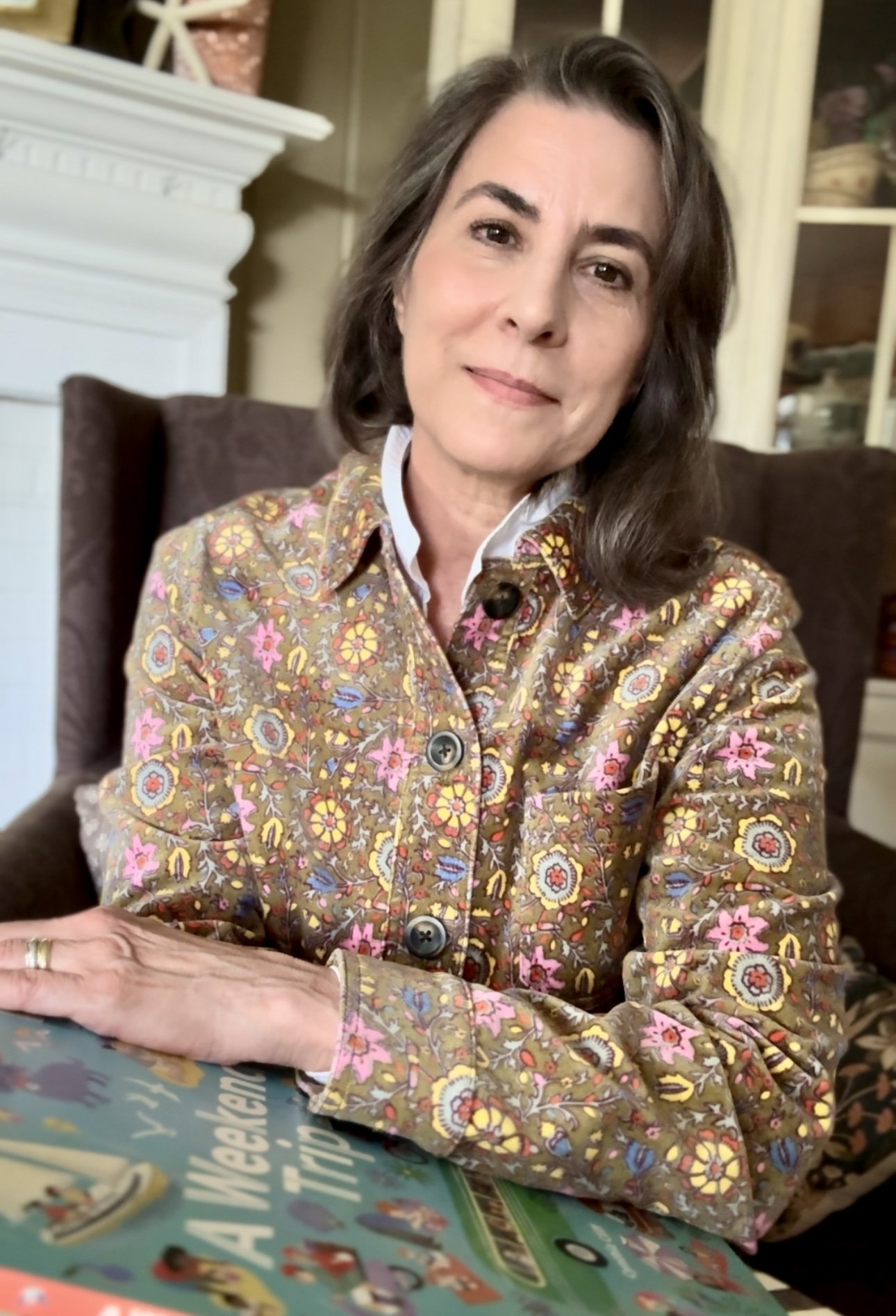
When I first met Cynthia Cliff at the Chesapeake Children’s Book Festival, I was instantly impressed with her work. As a museum-lover, I was particularly drawn to a postcard showing an upcoming book of hers, and I knew I had to learn more about her books and artistic journey:
Me: Congratulations on A DAY AT THE MUSEUM: A Find Pepin Book (Prestel Junior, Oct. 2025)! It’s a beautifully detailed experience (kind of like going to real museums!) What inspired you to create this picture book – or wimmelbuch?
Cynthia: Thank you, Jonathan! And thank you so much for having me.
Back in 2023 my editor at Prestel Publishing/Penguin Random House, Doris Kutschbach, suggested I consider making this style of book. I had already completed two traditional picture books with her, and she saw in my work the capacity for this kind of storytelling. I don’t think I would have thought of it myself. That is the beauty of a great editor or art director, they can see the possibilities and potential in an artist. Doris and the Prestel team I work with are in Munich, Germany, and Doris grew up with this style of book which is still very popular in Europe.
Prestel sent me a bunch of samples and after I did my research, Doris and I brainstormed a long list of topics that wouldn’t overlap Wimmelbuchs that were already in the market. The first book in the series “A Weekend Trip,” came out in 2024, and now we have “A Day at the Museum” and plans for more in this series. For your readers a Wimmelbuch is a wordless picture book that is “teaming” with details, numerous characters, and objects. It is often an oversized board book and is meant for the youngest readers. Children and adults use it in an interactive way, discovering all the hidden stories and creating their own stories to foster imagination and language skills.

Me: Such a cast of characters and treasure of details! How do you even begin planning each spread? What’s your illustration process?
Cynthia: Yes, some spreads have 90 characters I think (or I’ve been told, I didn’t count them)—the Prestel staff even made a spread sheet so we could keep track of them. We determined that we wanted to have human characters and not animals. Then I spent a ton of time doodling characters and building my little community. Each character is part of a “family” unit, and they are all varied and diverse. I created little back stories and characteristics for each family unit, so they’d react to the spaces they occupy in consistent ways. We knew we wanted to have a main character that kids would immediately be attracted to and so I came up with the idea of having a little dog. We named him Pepin, and he and his owner Carlo are the focus of the books. My idea was to have Pepin get separated from Carlo in each book. On every spread the reader must help Carlo find Pepin. All of the other characters are repeated on every spread and in every book in this series.
Before I began any of the illustrations, I did lots of research and built a large library of source images that I used as inspiration. This was especially important for “A Day at the Museum.” Each museum illustrated in the picture book is an amalgamation of numerous different museums around the world. I created a rough sketch of each spread to get approval on the general layout and concept. The next stage was producing a highly detailed drawing that showed how all the characters were placed within the scene and what other important elements would be included.
After the sketches were approved, I could start the color work. I built the background layer by layer on top of the sketch in a painterly and loose fashion. That was the fun and relaxing part. It usually took me about two weeks to create each background and all the details within the background. I could only work 3-5 hours a day on the illustrations because it was so tedious, and I also have a day job. After the background was complete, I added in the characters making sure they were consistent in their appearance, and that they fit their back stories. The character work took me another two weeks to complete. So, in total each spread took about a month to make after the initial sketches were approved.


Me: Though some may wonder how Pepin the dog could get to so many museums in one day, it could very well happen in my favorite stomping ground, the National Mall in DC. How many museums did you visit to research this book? Any favorites, near or far?
Cynthia: Yes, the idea is that it is a big museum that might have multiple rooms, or maybe it’s like the Smithsonian complex with lots of museums clustered together. I am a lifelong museum nerd. I love them all! I love the tiny, small-town museums and the big giant ones like The Met, equally. The Smithsonian Museums in DC feel like home to me, they are so familiar. Wherever I go I always visit all the museums I can. So, I already had lots of imagery burned into my brain from decades of museum visits. But for this book I did go down to the National Mall and hop around from museum to museum to observe people and how they reacted in the spaces.
Me: How did you get into creating books for kids?
Cynthia: Oh boy, that is a big question. As a child I loved making art, and I loved books just like most children do. I can still remember each one of my childhood books. We didn’t have many, and I wore the covers off the ones we had. At the time, way back in my mind I thought that one day I could be part of that world in some way—combining my love of drawing and my love for books, and that would be my world. But life happened and I went in another direction that felt more obtainable and safer. I didn’t study art and I didn’t try to make any art for over 35 years. In 2016 when my children went off to college, I started looking for a fun hobby and I started drawing. I didn’t start with much ability, but I fell deeply in love with art making and the challenge to get better. That love kept moving me forward and I searched for a way to make it a bigger part of my life. I kept practicing and drawing as much as I could. In 2017 while searching for an organization that would help me learn and grow, I found SCBWI. I knew then that I’d found my people. In 2018 an agent found me via an SCBWI portfolio showcase. Then in 2019 an art director found me and now in 2025 I have several books out in the world. I was finally able to make my way back to a little girl’s ambition and dream for her world, and I am so grateful to be here.
Me: Can you share what you’re working on next?
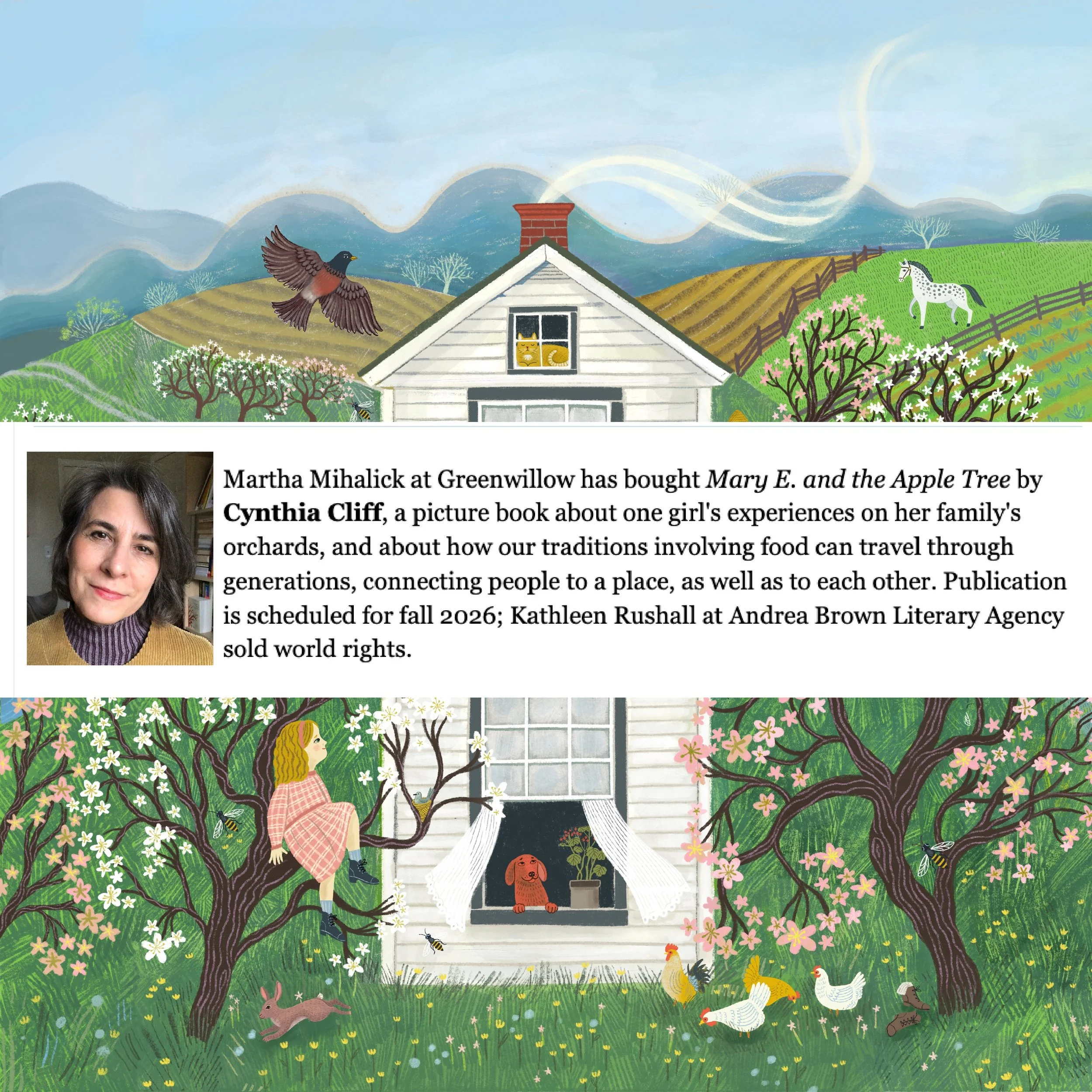
Cynthia: Oh yes! I’d love to share, outside of planning additional adventures for Pepin and friends I am working on two books that are very exciting. One is “Mary E. and the Apple Tree” to be published by Greenwillow Books/Harper Collins, out in 2026. This book is a personal story that I wrote while musing over scores of photographs of my ancestors taken between the 1850’s and early 1900’s—photos I never knew existed until just a few years ago. It is a lyrical story about how Mary Elizabeth, my second great grandmother’s life echoes in my own life and the things that connect us. I am putting a bow on the final illustrations as I write this.
The second book I am working on is with Nancy Paulson Books/Penguin Random House and I am the illustrator for the fabulous author of adult books Virginia Postrel. The book is entitled “Veronica’s Summer of Silk”, and it is Virginia’s debut picture book, a spin off that developed after her creation of the magnificent history book “The Fabric of Civilization.” I’m so excited to work with Nancy and Virginia to create the visual world for this story about a young girl in the silk mill industry in 1680 Italy. I am just getting started on this work, so look for it in 2027.
I am of course always writing new stories and will hopefully start work on a dummy or two for some new book ideas to submit to publishers.
Me: Thank you so much for chatting, Cynthia. Wishing your book much success!
Cynthia: My pleasure, and the same to you. Thank you!
To learn more, please go to Cynthia Cliff.