
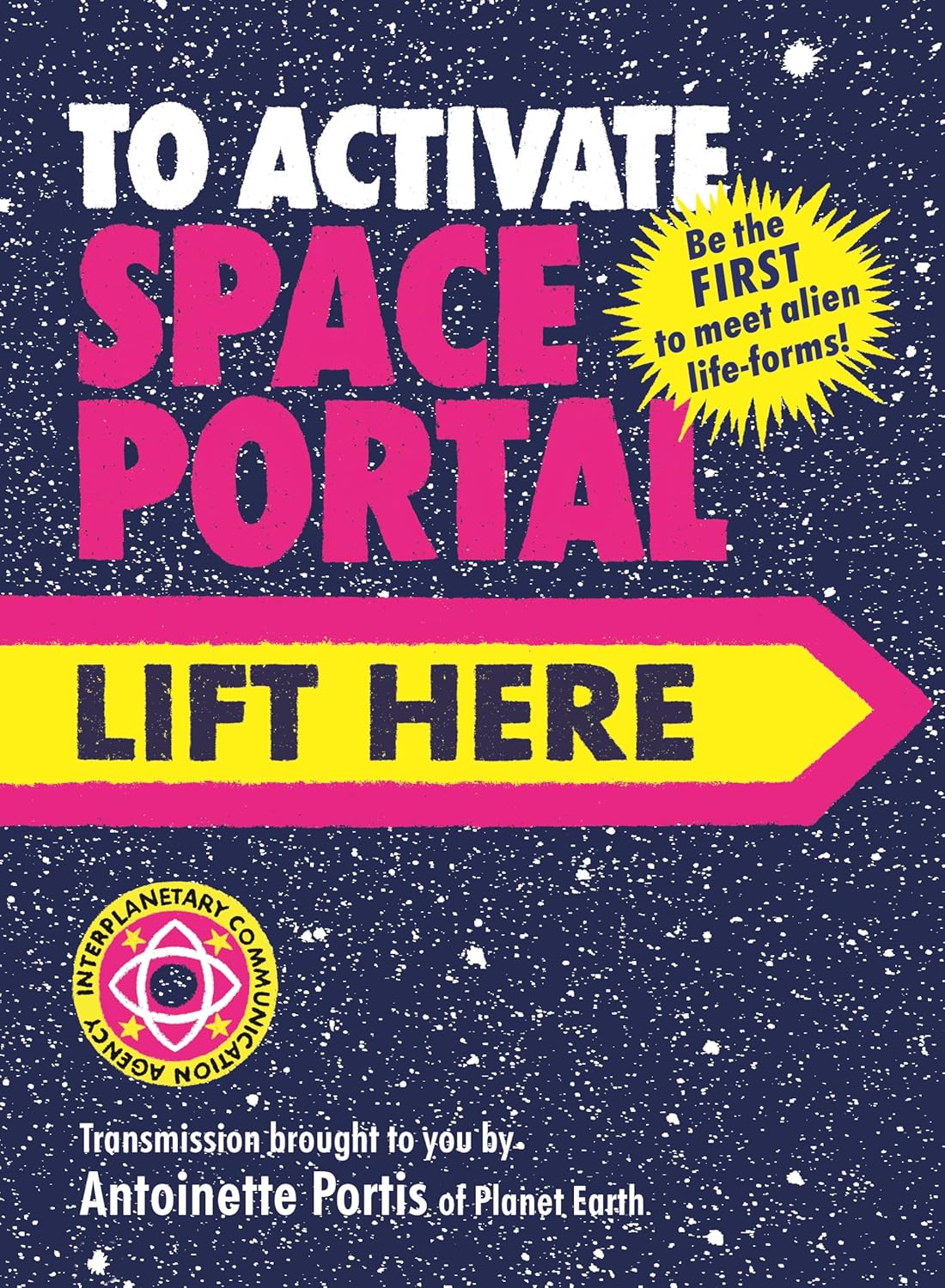
I love humorous books about aliens and I love all books by Antoinette Portis, so when I heard she was working on a new project that was going to bring us face-to-face with some interstellar friends, I knew I had to learn more:
Me: Congratulations on TO ACTIVATE SPACE PORTAL, LIFT HERE (Neal Porter Books, Oct. 2025). It’s delightfully fun and interactive first contact! What inspired you to create this book?
Antoinette: Thank, Jonathan!
I started out being snagged by the idea of the relativity of perception. I woke up morning with the image of seeing a monster, far away, through the frame of a window–so it looked tiny, unintimidating. Then I pictured the monster standing right outside the window–then the monster was terrifying. Somehow (no idea what route my mind traveled) the idea morphed into seeing aliens through a space portal. But it was the aliens who felt threatened and wary. To them, we would be the scary aliens. That idea of flipping to the aliens’ POV would have amused me as a child, so I played with it to see if I could make it work as a book.

Me: I first discovered your books back when A PENGUIN STORY came out, and I still use it in my elementary art room! As well as being a joy, your books have a distinctively strong graphic style. What’s your illustration process, from planning to final art?
Antoinette: That’s great! I love that you use my books in your art room.
I’m going to go really wide with my answer to this one!
I don’t exactly think of myself as an illustrator. I am definitely a picture book maker. What I love is meshing words and pictures together. It’s a process similar to my practice as a graphic designer—communicating through synthesizing words and pictures into a seamless whole.
I’m definitely influenced by traditional Japanese art and design, so I would say my impulse is always to distill things down to a state of simplicity. But not simplistic-ness (I made up a word there.) I see each book kind of like an iceberg—most of the substance is under the surface. I want deeper meaning present in my work without making it obvious. (Sneak attacks!) Anyway, that’s always my goal and that’s what keeps me fired up about this particular art form. PBs may look simple but they can pack a wallop that stays with you your whole life.
I usually start with either an image or a phrase that tugs at me to explore it, to see what riches it might offer up. (Sometimes none). But ideas come in an infinite supply, so if one is obstinate and unyielding, I move on to a more cooperative one. I tend to write a text first, to see if the idea can sustain the length and rhythm of a PB. (Some ideas are abstract and don’t naturally build to an ending. Then I have to trust that a satisfying resolution will show up as I work through the book.)
Once the text tells me that the idea can indeed be a book, I start drawing (really soft pencil on paper to get a nice fat textured line.) I scan the drawings and make a dummy in Adobe InDesign. As the text and pictures speak to each other, push at each other, I go back and forth between the two, editing, changing, and adjusting the power balance between the two. A drawing might steal the punch line away from the text (I love that!), or an image might need more support from the words to get the moment across.
I’ve started to discipline myself to think of each spread as a specific communication: what needs to be understood by the reader at this point in the book? How best does a combination of words and pictures make this particular moment in the book clear and engaging? That seems obvious, I guess, but working on “To Activate Space Portal, Lift Here”, a 56-page picture book that is mainly a series of talking heads, I really needed to understand what facial expressions, body language, and page composition best expressed the intention of each spread. Plus, each page needed to be interesting with a really limited set of ingredients. This is one of the few books I’ve done where the text (entirely in dialogue) propels the reader along. Usually I make the pictures do most of the work, but the format of this book created major restrictions—the challenge was to make what pretty much looks like a FT call into an engaging and varied series of images.

What art style to use is also part of figuring how to illustrate a book. In A Seed Grows, the whole life cycle of a sunflower seed is told visually by the repetition of a seed’s teardrop shape. The shape forms sunrays, raindrops, flower petals, leaves, birds’ bodies and wings, all part of the seed’s environment. Printmaking was a natural choice there. I carved the seed shape into linoleum blocks and printed the shape repeatedly to emphasize the theme of repetition and interconnectedness in nature.
I do get frustrated that I am limited as an illustrator. When I worked as a designer and then art director, I could hire any illustrator I thought would be the best fit for a project. But as an author-illustrator, I can only hire myself! Sometimes I write texts that don’t fit what I feel I can do well as an illustrator, so I can’t be the one to finish them into book form. But I’ve learned to be a better illustrator and extended the range of styles available in my toolbox and, as a writer, have lined up plenty of work to give myself as an illustrator.

Me: How did you get into creating books for kids?
Antoinette: I was a reading-obsessed kid. In summers, I would often check out a stack of books from the library, read all day and night, and then go get another stack. I remember one time having a splitting headache from reading so much, but just. could. not. stop.
Here’s a photo my father took of me that I put in my 5th grade autobiography.

So, books have always been in my heart and mind.
My ambition from 5th grade on was to write and illustrate a fantasy novel like a Narnia book. But it took a circuitous journey to get back to my desire to write for children. I went to art school and thought my life would go in that direction, but being a video performance artist did not pay the bills. But graphic design was a way to be creative and also make a living. Design led me to advertising and that led me to working in Disney Consumer Products (where it was all about kid-oriented illustration and design) for close to 9 years. That stint connected me with creating cuteness rather than coolness.
When I left Disney to find/reclaim my own creative path, I thought, I’ll either be a site-specific installation sculptor or write and illustrate children’s books. I knew the art world wasn’t going to embrace a woman my age, so I plunged into learning about picture-book making. When you live in LA, there are lots of resources available, so I took a bunch of classes, joined crit groups, wrote, drew, submitted. The second project I sent to a publisher was Not A Box. It got published and launched my new life as a picture book maker.

Me: Do you have any advice for aspiring (or seasoned!) picture book creators?
Antoinette: I would say first and foremost: love the art form that is the picture book. Study it and get to know what it can do. It takes patience and dedication to master anything worth doing, and children deserve our best and sincerest efforts.
And, as Maurice Sendak said, respect your audience: children are humans and feel what we feel as adults. They operate with a higher dose of energy, innocence and joy in their daily lives (we hope) but they also know conflict (ever had a sibling?); sadness (remember that goldfish floating upside down in the bowl?); frustration (ever had a hard time learning a new skill?); envy (ever wanted the shiny bike your friend has?). They experience the full range of human emotions. It’s important to work from your memories, feelings, experiences as a child when you write for children, not give them a grown-up’s didactic lecture. The best advice I ever got about writing for kids was from Barbara Bottner, my writing teacher for many years. She said to look back to your childhood and write about something that mattered to you then. Her theory is that everyone has a particular age they most identify with. That’s how Not A Box came to be. When I thought the way she suggested, I remembered how intoxicating it was as a kid to entertain myself with my own imagination. That advice was a superhighway to finding my voice as a picture-book maker. I got out of my grownup head and into the child mind. So my best advice is to give that advice a try!
Oh, and be persistent. A rejection is not the end. If you love the work, keep at it. How many stories have we heard about now supremely successful writers who heard NO over and over again?
Me: Such great advice! Thank you so much for chatting, Antoinette. Wishing your book much success!
To learn more, please go to Antoinette Portis.

