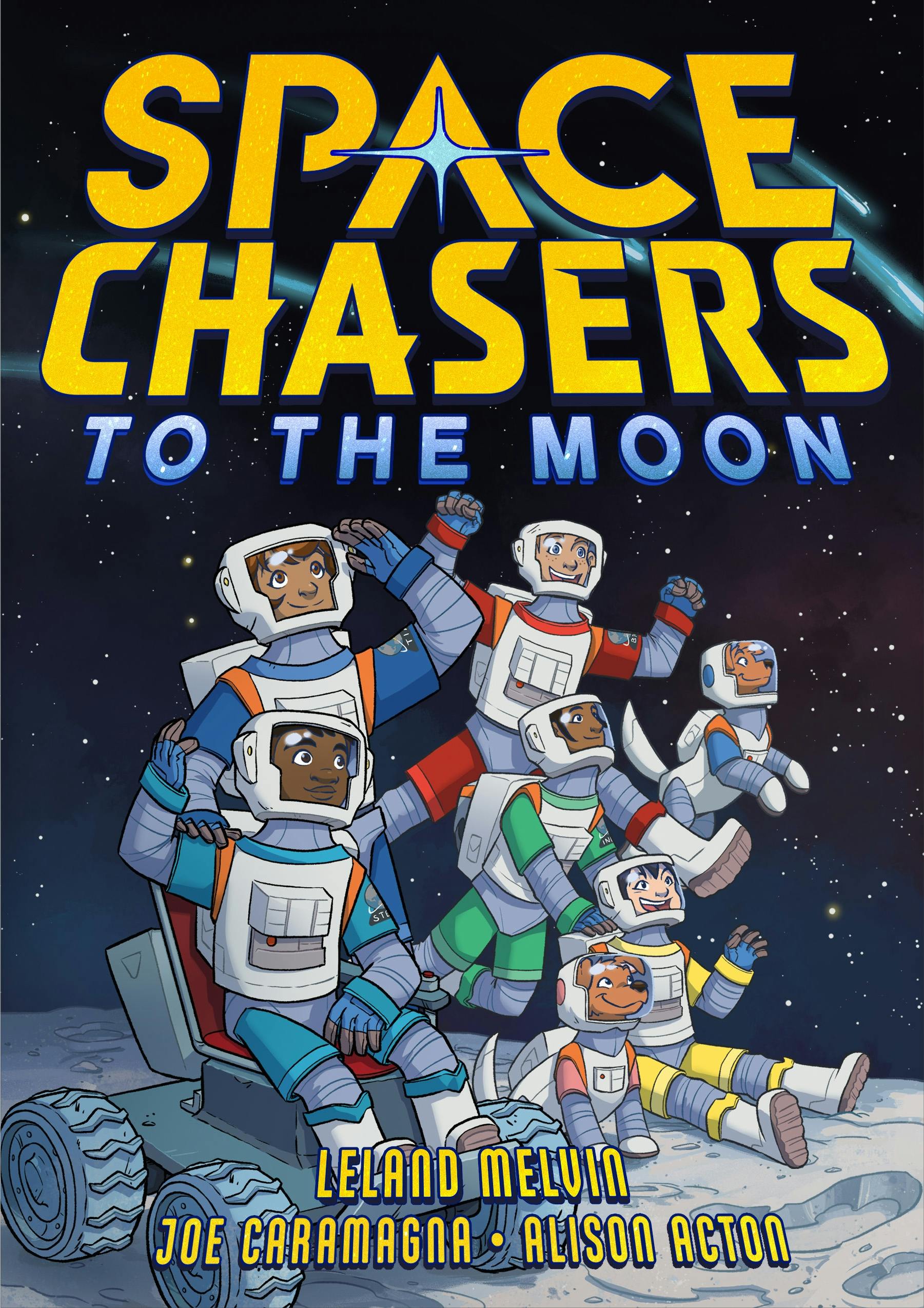
Twice last year I had the honor of appearing with author/astronaut Leland Melvin (at Scrawl Books and the Gaithersburg Book Festival) when his fun graphic novel Space Chasers came out. Luckily the adventures didn’t end there, because book 2 just blasted off! We’ll be talking about it at the Gaithersburg Book Fest again this Saturday, May 16 at 11:15. In the meantime, here’s what Leland said about his new title:
Me: Congratulations on the release of SPACE CHASERS: TO THE MOON (First Second, Feb. 2026), the touching and exciting second volume of your graphic novel series! It’s great to see the Steam Team back for another adventure. What inspired you to create this series?
Leland:I think the biggest inspiration around the series was to let all kids see what is possible no matter what background or zip code you are from. And that if you work hard and together as a team you can do pretty much anything.
Me: Both Space Chasers books are grounded in the experiences and emotions of a diverse group of ordinary middle schoolers. What do you want kids, particularly those that struggle, to take away from this story and your own life story?
Leland: Everyone in life struggles at something so if you struggle you are really not alone. It’s good to ask for help if you need it and you should always have a person you can talk to, to help you get through it.
Me: Alison Acton’s bold and detailed illustrations really take us along for the ride. What was your experience or involvement in seeing her help bring your words to life?
Leland: My cowriter Joe and I worked closely with Alison on the graphics but her first cuts were usually spot on. She has such an uncanny knack of putting to words what Joe and I were trying to envision with the series.
Me: I know you’ve been following the Artemis missions. What are your hopes for the next steps of lunar and planetary exploration?
Leland: I’m very excited about the future of the NASA Artemis program with Missions 3 and 4 where there will be boots on the lunar surface again!
Me: I’m excited that book 3 will be out next February! Any more plans for the Steam Team? Can you share what you’re working on next?
Leland: Joe and I are working on a new series but can’t discuss it just yet. It will definitely have space, dogs, curiosity and exploration.
Me: Looking forward to learning more! Thank you so much for chatting, Leland. Wishing your book much success and see you at the Gaithersburg Book Festival!
It’s always a pleasure discovering kindred spirits – fans of space history trying to bring interesting, but not as well known, stories to young readers. When I learned author Kerry O’Malley Cerra was writing about just such a topic, I knew I had to learn more:
Me: Congratulations on your fascinating new picture book, THE GALLAUDET ELEVEN: The Story of NASA’s Deaf Bioastronauts (Little, Brown Young Readers, March 2026)! I love learning about unsung contributors to the space race era, and this one was totally new to me. What inspired you to create this book?
Kerry: Thanks so much, Jonathan! I’ve always been drawn to unsung heroes. Growing up in Orlando, I watched shuttle launches regularly, and summers on Cocoa Beach meant feeling the ground shake as they lifted off. I was pretty obsessed, especially after the movie Space Camp came out.
This story found me in a more roundabout way. I’m late-deafened and have lived with hearing loss most of my life. A few years ago, I visited Gallaudet University while trying to imagine what it might feel like to live in a d/Deaf-centered community. I came across the Gallaudet Eleven exhibit there, but I wasn’t in the right headspace at the time to fully take it in.
Then, during the pandemic, my agent, Janine Le, asked if I’d heard of them, which jogged my memory. She suggested I might be the right person to tell their story. So, by day, I was scrambling to build a virtual school library as a high school media specialist since we were still homebound, and by night, I was deep in research. The more I read, the more I knew I had to write this book.
Me: What were the research challenges in putting this book together? Are there many records available or did you mainly rely on the three bioastronauts you were able to meet?
Kerry: Research-wise, I was fortunate. There is one particularly detailed primary source, from Robert Greenmun (one of the bioastronauts), who documented both the science and his personal experiences in letters to his family. Additionally, the original exhibit at Gallaudet, curated by Jean Bergey and Maggie Kopp, is now online and was instrumental. Other items, like Dr. Graybiel’s actual research and assessments, took a lot of archival digging. So while the men and this project have never been widely known, thankfully, the information was plentiful.
But the real gift was connecting with three of the four surviving men—Barry, David, and Harry—during the writing and editorial processes. Their firsthand accounts and fact-checking were invaluable! I later met the fourth one, John, at the book launch in D.C., when all four were reunited—some of them for the first time in decades. It was unforgettable.
Research aside, there were still many challenges in writing this story. The biggest was voice. This was my first nonfiction picture book, and the material is quite technical. Finding a way to make the story clear, engaging, and kid-friendly took time. Not to mention making it concise. I tend to be overly wordy; it’s why I write novels! I rewrote the manuscript eighteen times before it sold. By draft fifteen, I had interest from an editor (but no offer of a sale). She kept pushing for more heart, and I was at a loss. Thank goodness for my amazing critique partners who are well-versed in picture books. I couldn’t have gotten here without their expertise.
Other challenges included the comprehensive timeline, solidifying meaningful backmatter, and deciding what to cut (so, so hard!) while still honoring the men’s story.
Me: Even though I love space stuff, I don’t like speed, heights, confined spaces; I have the wrong stuff for sure. What about you? Would you take a trip in a rocket if you could?
Kerry: I always wanted to be an astronaut. I grew up watching shuttle launches, and for a long time, nothing—not even seeing Challenger explode in person—shook that dream. My 20-, 30-, even 40-year-old self would’ve said yes without thinking twice. I would’ve hopped on the Vomit Comet, too.
But I’ve gotten less daring over time. And a lot more prone to motion sickness. If NASA called today, I’d probably say no… which makes me a little sad to admit. Then again, maybe I’d surprise myself.
Me: Kristina Gerhmann’s lively and detailed illustrations really help evoke the excitement and the challenges of the bioastronauts. How were you two put together and what was your experience seeing her illustrations bring this story to life?
Kerry: I felt strongly that this story should be illustrated by a d/Deaf artist. I shared that with Little, Brown, and after some discussion, we narrowed it down to two illustrators who created sample sketches. Kristina’s drawings—especially her rocket—really solidified it for everyone.
Seeing the final art was incredible. There are so many standout spreads, it’s impossible to choose a favorite. I’ve done a lot of school visits since the book came out last month, and at nearly every one, kids comment on the cover. It’s such a fun, inviting image. Plus, it leads to discussion about vomit, which kids seem to enjoy.
And I know Barry, David, Harry, and John enjoyed seeing themselves brought to life on the pages. So fun!
Me: How did you get into writing books for kids?
Kerry: I loved school, but I wasn’t a great student, and I once had a teacher tell me I’d never be an astronaut because my math and science grades weren’t strong. True story. I eventually became a high school social studies teacher instead, inspired by all of my former social studies teachers, the kind of teachers who emphasized big picture ideas, critical thinking, and excellent discussions over memorization.
But as my hearing loss progressed, I couldn’t have those same deep and important conversations with my own students, so I stepped away. Not long after, I saw a small ad in the back of a magazine asking, Have you ever wanted to write for children? I hadn’t, but I’d always loved books, so I gave it a shot. That led to classes, critique partners, SCBWI, and eventually my first book.
Writing gave me a way to stay connected to kids.
Me: Can you share what you’re working on next?
Kerry: Sure! I have a fiction picture book, A Name Sign for Seraphina, coming out with Little, Brown BFYR in January of 2028. And while I’m mostly focusing on marketing for The Gallaudet Eleven book at the moment, I am revising a middle-grade novel and a picture book, while several new ideas are orbiting my brain. At some point, I just need to disappear somewhere quiet for a week or so and actually get back to writing.
Me: Thank you so much for chatting, Kerry. Wishing your book much success!
Kerry: Thank you so much for inviting me here, Jonathan. Your blog interviews are always so fun!
Hey, kids, what if you could have a robot teacher? No, wait, don’t answer that! First read this prescient new book by Sam Hepburn. Sam is a Scottish-Malaysian writer and cartoonist who lives in England, but I used a fancy new-fangled machine called a computer to contact her all the way across the pond and this is what she said:
Me: Congratulations on your recent graphic novel SCHOOLBOT 9000 (Dial Books for Young Readers, 2025)! It’s a fun, engaging read, but also an almost-too-close-to-reality satire on some very real issues. What inspired you to create this book?
Sam: I used to be a tech writer for a big corporation so I was always reading up about new advances in AI; I found the social and ethical questions really fascinating. I knew that people were exploring AI in schools and it got me thinking about a story where one boy might be the only kid in the entire school who didn’t like robots…
Me: I’m not anti-tech, but as an art teacher (and book creator) I break in cold sweat at anything AI (though I also like certain robots, especially the planetary exploring kind). What are some things we can do to make sure tech like this doesn’t take over our lives?
Sam: I always say I’m not anti‑tech, I’m pro‑humanity. The best way to make sure any kind of technology doesn’t take over our lives is to keep your critical thinking cap on. The world is always telling us to be faster, more efficient, more “perfect”. But we don’t have to use every new tool just because everyone else is. It’s down to us to take a minute and ask: Why? Will this really help me, or will it lead to problems later? If I decide to use it, what kind of safeguards do I have access to? It’s more important than ever to question things.
Me: Graphic novels, we both know, are a lot of work! What’s your workflow like? Any steps that are particularly enjoyable or challenging for you?
Sam: I usually start with writing. I like to work out a long, detailed outline – almost a script – and make sure the story and characters sound how I want them to. I come up with catchphrases, captions, slogans – little bits of writing that feel right for my story. It’s like word maths! I spend a lot of time getting the sequences and combinations of words right and making sure my thoughts are coming out clear on the page before I start drawing. It’s the same when I’m writing my weekly gag cartoon Questionable Quotebook or my webcomic ET CETERA. I think it’s because I started my career as a writer, so that’s the quickest route forward for me. And then I start scribbling. And when I say scribbling, I mean it! I try to give myself the absolute least pressure possible so I draw scenes really scrappy and small before I commit to them.
Me: How did you get into cartooning?
Sam: Before I became a cartoonist, I used to work as a copywriter in a big advertising agency. I got to have fun being creative every day, but there were plenty of frustrating times – and there was humour in it too. I started making a comic strip about my experiences, called Welcome to Agency X. At the same time, the editor of Malaysia’s national daily, The Star newspaper, was looking for a new comic strip to add to the funny pages. (She actually wanted to replace The Amazing Spider-Man with a comic strip by a local cartoonist!) Somehow, she heard about my work in progress, and I went from writing zero comic strips for zero readers, to writing six comic strips per week for a year to a readership of 1.8 million!
Me: Not to spoil anything, but you left us on a cliffhanger. Can we expect book 2 soon? Anything else you’re working on that you want to share?
Sam: I’m still working out the specifics for a Schoolbot 2, so I’m afraid readers may have to wait a little longer! In the meantime I’m outlining a top secret new story – I’d love to surprise readers with something completely different in my next book.
Last year I ran some children’s comic workshops at local bookshops and schools here in England, and I’m planning to do more creative events like that this year. I really enjoyed getting to meet young readers and guide them to bring their own unique cartoon characters and stories to life. I’d love to run a creative event for adults as well, because some of the parents seemed to enjoy the comic workshops just as much as their kids!
Me: Thank you so much for chatting, Sam. Wishing your book much success!
In 2023 I was excited to meet author Vicki Johnson around the release of her debut picture book MOLLY’S TUXEDO. Molly earned much well-deserved praise, and with a follow-up due to release in just a month, I caught up with Vicki to learn more:
Me: Congratulations on your joyful new picture book, MAC WEARS A HAT (little bee books, April 2026)! It’s an exuberant look at the myriad of emotions going on in one child’s head – and on it! What inspired you to create this book?
Vicki: Thank you. For inspiration, and similar to my first book Molly’s Tuxedo, I am still in that phase of writing out of personal experiences. I promise I write about other things than clothing items! But clothes, including hats, are one of the categories of things that a child has some agency over, so it’s a way for me to explore decision-making and self-awareness. And then of course, after the child decides what they want to wear, comes immediate feedback, whether that’s good or bad, from both adults and other kids. So, there’s the part of the interaction with others that is so important as one grows into oneself and understands how to interact with others that interests me. I believe wholeheartedly in the child’s inner compass, and how strong they have to be to pay attention to that and hold onto it, regardless of their surroundings.
Me: We all wear many hats these days. Do you have any favorite hats – either literal or metaphorical?
Vicki: My literal favorite hats are probably trucker hats and Peaky Blinders style newsboy caps! My metaphorical favorite hat is definitely being a parent. I’m entering another bittersweet moment in that role, as my daughter graduates from college soon, and moves on into the big world. My heart aches with worry, but I’m so, so proud. I also love being a children’s author and continually learning about craft. I have so much to learn! It keeps me busy which I really crave.
Me:. Gillian Reid’s bright and inviting illustrations really bring out Mac’s expressive zing. How were you two initially put together and what was your experience seeing her illustrations bring this story to life?
Vicki: I tell everyone I am Gillian’s biggest fan. We were put together by our editor at Little Bee Books, Charlie Ilgunas, for our first book together, Molly’s Tuxedo. What luck for me! I found out later that Gillian took that project because the story also resonated with her and her childhood. I love how she brings emotion to the characters and adds layers and energy to each scene. She has a clever sense of humor and is so brilliantly skilled at showing emotions through the character’s gestures. She also creates the best animal characters, which of course I adore, and young readers do too.
Me: How did you get into writing books for kids?
Vicki: I was fully in the middle of my life and career as a lawyer when I had my daughter, and reading to her each night reminded me of how much I read as a child, and how rich and important the stories were to me. Books were lifesaving to me as a child, truly. I decided to try to write something and have been trying ever since. I started by writing a middle grade novel during National Novel Writing Month and then was lucky enough to have a neighbor who told me about SCBWI, which is such a great starting point for so many new authors and illustrators. I just stuck to it, and worked in the early hours before work, and every time I wanted to stop, I just kept going. And here I am, still going.
Me: Can you share what you’re working on next?
Vicki: I have three picture books that I’m polishing and will be querying very soon. My wonderful agent left the business recently, so I find myself back in the query trenches. I’m super excited about these stories though, so hopefully I will find the perfect publishing partner with one of my new stories!
Me: Thank you so much for chatting, Vicki. Wishing your book much success!
Light is one of those things: everywhere and immeasurably important. Yet also kind of hard to understand. As I’m ever on the lookout for good creative non-fiction books for kids, I was excited to learn that author Henry Herz was tackling just this subject. I caught up with Henry to learn more:
Me: Congratulations on your enlightening (see what I did there) new picture book, I AM LIGHT (Tilbury House Publishers, March 2026)! It’s a stunning follow-up to your books I AM SMOKE and I AM GRAVITY. What inspired you to create this book?
Henry: Thanks, Jonathan. The short, practical answer is that Tilbury House wanted to continue the series of anthropomorphic autobiographies. And I needed little encouragement. I love the idea of physical phenomena explaining themselves to young readers. Light, like Gravity from my previous book, is essential to life on Earth. I knew the immensely talented illustrator Mercè López would rise to the challenge of conveying ephemeral or invisible protagonists with her stunning artwork.
Me: Once the lightbulb goes on for an idea like this, how to do go about researching, planning and writing it into picture book form?
Henry: Hey, you’re encroaching into my pun domain! I research the science behind the phenomenon, documenting concepts I think will be interesting to kids. I also massage the “protagonist’s” voice into the lyrical form established in I AM SMOKE. An ancient “being” would speak with gravitas, I think. Any fascinating science that’s a bit too complex for the picture book’s story text may end up in the STEAM-friendly back matter.
Me: Mercè López’s dynamic illustrations really help illuminate these simple but difficult concepts. What was your experience in seeing her bring your words to life?
Henry: In a word, flabbergasted. I remember when I first saw her sketches for I AM SMOKE and my jaw dropped. “Honey, come see what the illustrator did!” Her brilliant work made me a very happy camper, and she’s now delivered amazing artwork three times. She’s also incredibly innovative, capturing real smoke for artwork in I AM SMOKE. For I AM LIGHT, she manipulated long-exposure photo shoots, light sources, effects, and movements.
Me: How did you get into writing books for kids?
Henry: Accidentally. Many years ago, I wanted to share my love of fantasy with my young sons. So, I decided write a fantasy book for them. That decision had two unintended consequences. First, I did not anticipate was that my boys would give me feedback on the story. They devised some of the character and creature names, and made plot line suggestions. And who better to help make the story appealing to kids than other kids? So, the goal of interesting my sons in fantasy transformed into also encouraging them to write. Second, I discovered how much I loved writing. We ended up self-publishing that book. I was hooked on writing. I became a SCBWI member, joined a critique group, and kept honing my craft until I sold my first picture book, MONSTER GOOSE NURSERY RHYMES, to a traditional publisher, Pelican.
Me: Can you share what you’re working on next?
Henry: I AM WIND, the fourth book in the I AM series from Tilbury House, is scheduled to come out in the Fall of 2026. I have other picture book projects my agent is subbing. I also write fantasy, sci-fi, and horror short stories, plus I edit adult anthologies. My horror anthology, WATERBORNE, just released. THE BIG BAD BOOK OF KAIJU (co-edited with Jonathan Maberry for Titan Books) should come out by year’s end. DEATH MAIDENS: OFF-DUTY VALKYRIES (Penguin Random House) is scheduled for January 2027. Other picture books, short stories, and anthologies are always in the works.
Me: Thank you so much for chatting, Henry. Wishing your book much success!