Getting to Know: Billy Sharff

Amazon.com: Robot's First Snow: 9781728279992: Sharff, Billy, Abbo, Hannah: Books


I love robots (think real rovers and Rover and Speck). I also love winter (not!) But if it’s going to be winter, I wish it would at least snow. Hmm, I wonder what would happen if you combined a robot with snow? I caught up with author Billy Sharff to find out:

Me: Congratulations on your fun new picture book, ROBOT’S FIRST SNOW (Sourcebooks, Oct. 2025)! Robot really helps capture the joy – and work – that comes from a big snowfall. What inspired you to create this book?

Billy: Thanks Jonathan! This book started with a single image in my mind of a robot out in the snow. Something captivated me about this image—the stark soft beauty of winter, and a curious robot observing it all.


Me: Although I grew up in Michigan with feet of snow every winter, we don’t seem to have much anymore where I live now (DC Metro). Last week we had our first inch and kids in my classroom sprang to life. How excited are you still by snow?

Billy: I live in rural NH, so snow is a regular sight in the winters. I remember the true awe-inspiring sights of childhood snowfalls, the pinks and blues of sunrise and sunset over the pristine untouched snowland that changed all the world outside my window. I can still feel that wonder on special days, and my children help rekindle those memories.


Me: Hannah Abbo’s whimsical illustrations evoke both the coldness of the day and the warmth of the characters. What was your experience seeing her illustrations bring your story to life?

Billy: I think she did a wonderful job. She used color in an especially evocative way, bringing warmth to the humans, and the world around.


Me: How did you get into writing books for kids?

Billy: I’ve always loved children’s books. They feel like a bright spot in a sometimes-bleak world. Having kids turned my focus to children’s literature more attentively, but I’ve always been interested in writing for younger readers.


Me: Can you share what you’re working on next?

Billy: My next book up is called Rock & Pebble, due out from Dial in 2027 I believe. It’s my favorite book so far, told in very short stories about two friends, a rock and a pebble, who sit there, immobile, and observe the world, wonder at it, and talk/argue/discuss.

Me: Sounds intriguing! Thank you so much for chatting, Billy. Wishing your book much success!

To learn more, please go to Books | Billy Sharff Books.

Getting to Know: Alice Faye Duncan


I had the honor of speaking alongside Alice Faye Duncan at the 2024 History Book Festival in Lewes, Delaware. Alice is a longtime educator and a prolific author who has not one but two inspiring new books releasing this month! I caught up with Faye to learn more:

Me: Congratulations on your moving new picture book, THE DREAM BUILDER’S BLUEPRINT: Dr. King’s Message to Young People (Calkins Creek, Jan. 2026)! Many titles have been written about Dr. King for young readers, but it looks like yours may be the first to use words he aimed at a young audience. What inspired you to create this book?

Alice: I wanted to give students information about Dr. King that was new to them, and unexplored in text books. In service to that mission, Dr. King’s 1967 speech at Barratt Junior High in Philadelphia is a powerful word, students need to hear on repeat. He told the young people, “Learn so you can earn.” He said, “Stay in school.” He said, “You are beautiful.” The social climate today is not beautiful but children need to know—they are.


Me: I’d never heard the term ‘erasure poem’ before. How did you choose which words to ‘erase’ – a daunting task given the source material! – and how did you know when you were done?

Alice: I transformed Dr. King’s speech with 1700 words into an erasure poem composed of 270 words. His speech is now a lyrical “commencement” chorus for young people who are 5 years old to 100. Finding my voice and rhythm within Dr. King’s thunder was a challenge.  I made more than 50 photocopies of the speech on poster-sized paper. This allowed me to erase text, reconnect words, and erase again, until at last, I unearthed an impactful affirmation suited for the present times.

Me: The illustrations by the ever-amazing E.B. Lewis bring a visual poetry to match the words. How were you two put together and what was your experience seeing his illustrations shape this book?

Alice: I share an editor with E.B. Lewis. Her name is Carolyn Yoder. When I expressed to Carolyn that I’d love to work with an illustrator who is from Philadelphia, the city where Dr. King gave this particular speech, she suggested E.B. He is very busy and I had to wait for his availability. But the wait was worth it. His illustrations capture the spirit and mood of the poem’s message in a very marvelous way.


Me: As someone who teaches (in my case, elementary art for almost 30 years so far) I’m always interested in meeting other educators who create books for young readers. What’s been your key to achieving this balance as an educator and writer?

Alice: I started my 1st teaching job and sold my 1st picture book to the MacMillian Publishing Company in the same year. That was more than 30 years ago. During this time, teaching has proven to be the perfect profession for me because the job allows for uninterrupted weekends, long holiday breaks, and two uninterrupted months in summer. Presently, I have published 14 books. Taking advantage of the school calendar, most of them were written across many weekends and several Christmas Breaks.

Me: Can you share what you’re working on next?

Alice: Next up is my picture book biography, BLUES BOY—THE B.B. KING STORY. The release date is January 27, 2026. Born in Mississippi and made famous around the world, B.B. King used his guitar like a poet. His blues music was a balm of grace and good times for every listener. Children today need Dr. King’s blueprint for progress, and they need B.B. King’s music for inspiration and joy. Please share these books with young learners in your care. Thank you! More information is available at www.alicefayeduncan.com.


Me: Beautiful cover, can’t wait to read that one too! Thank you so much for chatting, Alice. Wishing your books much success!

To learn more, please go Alice Faye Duncan – Picture Books, Dr. Martin Luther King, Writer.


Getting to Know: K. Woodman-Maynard


What would you do if you had the chance to live forever? Would you take it? Natalie Babbitt has had readers pondering this question since the release of her beloved novel TUCK EVERLASTING in 1975. I was lucky enough to meet Natalie Babbitt more than 15 years ago and have her sign my copy. Now I’m lucky to be interviewing K. Woodman-Maynard, who recently adapted this classic. I caught up with KWM to learn more:

Me: Congratulations on your touching graphic novel adaptation of Natalie Babbitt’s classic TUCK EVERLASTING (Farrar Straus Giroux, Sept. 2025)! It’s faithful to the original but also brings new life to the story that I’m sure will enchant fans and new readers alike. What inspired you to create this book?

KWM: My publisher reached out to me after seeing my graphic novel adaptation of The Great Gatsby (Candlewick Press). However, I wouldn’t adapt a book that I didn’t love and where I didn’t feel like I could genuinely add something to it. Tuck Everlasting has always spoken to me very deeply. The elements that make the book so powerful—the way Natalie Babbitt writes about nature, the symbolism, the characters, and the deceptively simple central question—are all things that translate especially well visually. I felt the story could be experienced in a new way through art without losing what makes it so beloved.


Me: What were some of the challenges in adapting such a beloved novel?

KWM: The biggest challenge was condensing the text while staying true to the original. I take adaptations very seriously and try to be as faithful as possible, though that doesn’t always mean being literal. Sometimes pacing or structure needs to shift slightly to work in a graphic novel. My main goal was always to preserve the emotional core of the book and let the art do as much of the storytelling as possible. But it’s always a bit painful to cut out text that I love since the original author’s words so much.


Me: Your art for the book is stunning. Can you talk about your process? I’m particularly interested in how you came up with the evocative shifting color schemes.

KWM: I work in a lot of iterations, starting very loosely and gradually refining the work, and switching back and forth between digital and traditional mediums. I create the line art digitally in Clip Studio Paint, then print it on watercolor paper and paint everything by hand. After that, I scan the pages back in and add lettering and panel borders digitally. It’s not the most streamlined process, but I enjoy it.

Color is a big storytelling tool for me. I limit the palette for each scene and focus more on emotional accuracy than realism. The colors shift depending on mood, and certain characters—like the Man in the Yellow Suit—required specific colors to appear whenever they were present. I also wanted nature to be especially vibrant, which is how nature feels to me, so I use more saturated colors there.


Me: How did you get into creating graphic novels for young readers?

KWM: I’ve always been drawn to visual storytelling, even as a little kid I would draw stories and comics. I student animation in college and then discovered graphic novels which combine everything I love about art and writing in a way that just works with how my brain works. Creating for young readers feels especially meaningful because kids are incredibly thoughtful readers and the graphic novel format allows for a lot of nuance without over explaining. I also found so much comfort from books as a kid (and as an adult) and I hope my books do the same for others.

Me: Any idea what you would do if you came across such a spring yourself?

KWM: I’d like to think I’d walk away. What the book makes clear is that living forever isn’t the same as living well, and that feels even truer to me now than it did when I first read it as a kid. I think I’d have a harder time denying the spring to a loved one was dying if it meant the spring could save them. I often wonder how Winnie handled that responsibility living her life right next to the spring.


Me: Can you share what you’re working on next?

KWM: I’m starting the script process of an original middle graphic novel that I’m very excited about. I also work as a graphic novel coach—helping comic creators find clarity and build momentum to tell stories that matter to them.

Me: Thank you so much for chatting, K. Wishing your book much success!

To learn more, please go to K. Woodman-Maynard.

K. Woodman-Maynard


Natalie Babbitt. Photo by Jesse Zellner

Getting to Know: Melissa Stewart


Melissa Stewart is a prolific non-fiction author who has written on topics ranging from Feathers to Whale Falls. But if there’s one thing that all her subjects have in common it’s…atoms. And now, I was excited to learn, she has a book about that too! I caught up with Melissa to learn more:

Me: Congratulations on your illuminating new picture book, FROM BAM! TO BURP!: A Carbon Atom’s Never-Ending Journey through Space and Time and YOU (Charlesbridge Publishing, 2025). What a simple and fun way to help us understand some very basic but hard-to-comprehend concepts! What inspired you to create this book?

Melissa: Thanks, Jonathan! This book began with a question from a curious kid. During a school visit in 2016, a third grader suddenly raised his hand in the middle of my presentation. He kept enthusiastically shaking it at me, so I knew I needed to call on him.

Here’s the question he asked (even though it had nothing to do with my presentation): Is it true that an atom that’s inside my body right now could have been inside a dinosaur 150 million years ago?

Yes, I replied. Not only is it possible. It’s extremely likely. There were billions and billions of dinosaurs, and atoms just keep cycling from creature to creature over time.

Hisa mind was blown. But then he had even more questions:

Where had the atom come from?

How did it end up in us?

Where else had it been along the way?

I didn’t know the answers to all those fantastic questions, but I was curious too. So I started researching. And 9 years later, we have a book.

Me: You write on so many topics and make them accessible to young readers. What advice do you give to other writers attempting to write nonfiction that can share the shelf with yours and so many engaging titles that are being published these days?

Melissa: Oh boy, that’s a great question. Sometimes I give specific craft tips, but my I also tell them to enjoy the writing journey and to celebrate successes—even the small ones!

So many things about book publishing are out of our control, and there are lots of challenges and disappointments along the way. That’s why it’s important to make a big deal out of every single bit of progress, from a “good” rejection to a starred review.

Me: Marta Álvarez Miguéns’ bright and inviting illustrations really help to visualize things that are literally unseeable. How were you two put together and what was your experience seeing her illustrations bring this book to life?

Melissa: Aren’t her illustrations such a delight? I love them so much. They complement the manuscript perfectly and elevate the whole book. Here are a few samples:


Many people think authors choose their illustrators, but most of the time the wizard behind the match is the editor or the art director or both. That’s definitely true in this case. Marta did so much hard work to understand the complex science in this book and then used her new knowledge to create art that’s playful AND completely accurate.

Me: How did you get into writing books for kids?

Melissa: Through the backdoor, I guess. I worked as a children’s book editor for 9 years, and my first few books were published during that time. When my brother had his first child, I wanted to move closer to them and be a doting aunt. That’s what inspired me to take the leap into freelancing and becoming a fulltime writer.

Me: Can you share what you’re working on next?

Melissa: In March, I have a book coming out with Sarah S. Brannen called Monarch to Mourning Cloak: A Butterfly Journal. It’s truly a labor of love for both if us. I wrote the poems over a 16-year period. Then Sarah created sample art, and we submitted the materials as a team. This kind of early collaboration is unusual, but we’ve been in a critique group together for more than 20 years, and we’d already created three books together, including the Sibert Honoree Summertime Sleepers: Animals that Estivate.


To make the art as accurate as possible, Sarah collected raised butterflies in her studio and sketched from life. Her are some spreads from the book.


The art is absolutely stunning! I can’t wait for this book to enter the world!

Me: Looking forward to it too! Thank you so much for chatting, Melissa. Wishing your books much success!

To learn more, please go to Home – Melissa Stewart.

Getting to Know: Claudia Rueda

 by Claudia Rueda


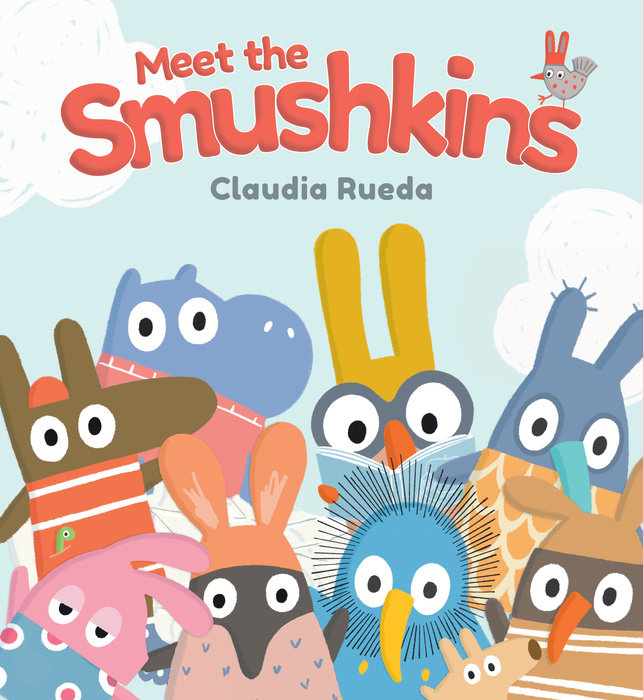
If you’ve seen any of my books, you’ll notice I like cute characters (at least, I hope they’re cute). But Rover, Beep and Speck have nothing on this new gang in town! I caught up with author-illustrator Claudia Rueda to learn more:

Me: Congratulations on your whimsical new picture book MEET THE SMUSHKINS (Candlewick Press, Dec. 2025)! Kids will love hanging out with this fun group of characters as they play and explore. What inspired you to create this book?

Claudia: Thanks so much, Jonathan! I actually came up with the first sketches of these playful, whimsical characters during the pandemic. Those were tough times, but they also gave me the chance to reconnect with my daughters, who were already in college. We got to be a little
silly again—dancing while cleaning up, baking and cooking together—basically doing the same kinds of fun things the Smushkins do! A couple of years later, I started creating stories for my new characters, and I’ve come to realize that they are a celebration of childhood and a metaphor for children’s play. I had already created some book ideas for the Smushkins, and my publishers at Candlewick and I decided it made sense to start by introducing the characters and following them as they search for a house where all their adventures can happen.


Me: I notice the Smushkins have lots of books and creative outlets – nothing electronic – as well as lots of times outdoors. It’s a perfect world to me, but maybe one today’s kids are experiencing less and less. What did you like to do as a child and how does that inform your
work for young readers?

Claudia: I’m glad you’re asking that question. There was a lot of free play and exploration in my childhood. My older sister and I were always making up stories, we’d explore our grandparents’ ranch with our cousins, and we played out in the street with our neighbors every single day. I wouldn’t call myself a nostalgic person, but I do believe it’s essential for us as humans to remain connected to the real world, to nature, and to our emotions.
Children build those connections through play and by interacting with the physical world around them. That’s also the way they learn to imagine and be creative. A screen just can’t offer those kinds of experiences, and the Smushkins are an invitation to keep it real.


Me: Your art for the book has an inviting and comforting simplicity, but simple can be deceptively hard. What was your process for planning and creating the Smushkins and their neighborhood?

Claudia: I trust my intuition when deciding the direction for the art in my picture books and also let the narrative lead me into the way the book looks. In the case of the Smushkins, I wanted the palette to look colorful but not too saturated, so I decided to use colors that are close
to the natural world. Also, I love 20th-century art and minimalism. That’s why I like simplicity and the narrative power of negative spaces, and also for the sake of rhythm and balance.

Me: How did you get into books for kids?

Claudia: I loved drawing as a kid, but I grew up where no one really imagined you could be an artist, so I kept it to myself. Later, I studied law and drew political cartoons. When my husband and I moved to San Francisco, I took a children’s book illustration class at UC Berkeley that changed everything—I realized picture books let me combine drawing, storytelling, and children. I started sending postcards to art directors and attending conferences. Eventually, one of my pieces won second place at a conference in New York, and one of the jurors, an art director from Scholastic, asked to see my portfolio. Weeks later, she offered me my first picture book. Since then, I’ve created dozens of books as an author illustrator!

Me: Can you share what you’re working on next?

Claudia: I’m finishing a third book about the Smushkins in the snow and a fun novelty book. I’m also working now on more stories for my characters where they will have to face obstacles, deal with new visitors and even visit haunted houses!

Me: Thank you so much for chatting, Claudia. Wishing your book much success!
To learn more, please go to claudia rueda.