Getting to Know: Brian Lies

Amazon.com: Cat Nap: 9780062671288: Lies, Brian, Lies, Brian: Books


I have a special place for picture books that incorporate art history in interesting ways. But just when I thought I couldn’t be surprised anymore, along comes a new addition to the genre that really took some new turns. I caught up with author-illustrator Brian Lies (best known for his Caldecott Honor Book, THE ROUGH PATCH) to learn more:

Me: Congratulations on your stunning new picture book, CAT NAP (Greenwillow Books, Sept. 2025)! I’ve seen characters step into artworks before – but not like this! What inspired you to create this book?

Brian: Thank you, Jonathan—and you’re right, there have been books with characters interacting with artworks before. I just haven’t seen one where the artworks the character visits are all near-forgeries of the originals, created in their original materials.

The book started with our part-Russian Blue / part Siamese cat disappearing one day and we couldn’t find him anywhere. He returned some hours later, completely nonchalant, with his whiskers covered in cobwebs. Where had he been? We joked that he’d found a wormhole in space and time, and maybe had gone back to ancient Egypt, where cats were revered. From there, it expanded to the idea that he’d had an adventure moving through artworks from a variety of cultures at the Metropolitan Museum of Art in NYC, and baked into it at the beginning was:  I want to see if I can create near-forgeries of all of these artworks!


Me: Not only is it a fun, whimsical journey through art history, CAT NAP is the first book in a while where I had to keep asking myself, ‘How the heck did he do this?’ So: How the heck did you do it?

Brian: I’ve always made things with my hands, so some of the materials and media were familiar to me—stained glass, for instance, which I learned to do in high school. But some techniques were new to me, and I either experimented with materials or learned from “YouTube University,” picking up techniques such as gilding. I bought a digital book on traditional stained glass painting, and it came with a number of tutorial videos, which were extremely helpful. Doing the final artwork for CAT NAP was a nine-month immersion in silicone mold-making, plaster casting, wood bending, wood carving and more—and it was an absolute blast. I don’t think I’ve enjoyed making art this much since high school, when everything I tried to do was new to me.


Me: Beyond the artworks, the living room is filled with many sumptuous – and perhaps symbolic – details: the red couch. The books. The lamp! Are these based on real objects? Any personal connections you’d like to share?

Brian: I’ve always been drawn to Arts & Crafts furniture, ever since I first visited the library which my book Bats at the Library is set in, the Riverside (IL) Public Library. It was my Dad’s childhood library, and I just loved their Arts & Crafts furniture. Most of the objects on the plate rail along the wall are things we have around the house, minor antiques…


Me: Any tips for younger authors and illustrators – digital natives – who may be interested in using more non-digital ‘old school’ methods for creating – and promoting – their work?

Brian: I think the most important thing for any illustrator is to work on craft—practice their drawing. I’d suggest real pencil-on-paper drawing, because the feel is different from working on a tablet, but developing your own skills outside of an app or software is essential. You carry it anywhere you go. Promoting work is very different—I’m not sure there is such a thing as non-digital promotion anymore!  We’ve done things like wrapping a vehicle with book images to draw attention at book signings, and creating hand-outs like stickers and temporary tattoos. But so much of the world’s promotional focus seems to be on TikTok, Instagram and other social platforms these days.


Me: Can you share what you’re working on next?

Brian: Happy to! My next book is called Diffy (fall 2026, Christy Ottaviano Books / Little, Brown & Co.), about a deep sea fish with a light similar to an anglerfish’s light, and what happens when a dictionary lands on a ledge of the seamount where he lives. It opens, displaying marginal illustrations he can’t understand—they’re completely outside of his world. Frustrated by not understanding them, he begins to group things together in his imagination and share his rudimentary stories with other fish. It’s essentially about how the human brain can’t help but try to find patterns and make sense of the incomprehensible by creating stories.

Me: Wow, can’t wait! Thank you so much for chatting, Brian, about your amazing book and process. Wishing CAT NAP much success!

To learn more, please go to Brian Lies.

Getting to Know: Audrey Helen Weber

Year Round: Weber, Audrey Helen: 9780823457205: Amazon.com: Books


The seasons are their own kind of art, and they also inspire art. Books about the seasons will never grow old, especially in the able hands of creators like Audrey Helen Weber, whose new book just released. I caught up with Aud to learn more:

Me: Congratulations on your evocative new picture book, YEAR ROUND (Neal Porter Books, Oct. 2025)! It’s a fresh and inviting look into the experiences of a full year. What inspired you to write this book?

Audrey: Thank you so much! I wrote the first line, “can you peel a clementine all in one go? Can you hear the hushushush of the falling snow?” a long time ago for another project. When I returned to the idea I used the four part structure of the seasons to write and draw more scenes, which built up a little world of children experiencing the year together. Sometimes I would write first and sometimes I would make a picture and figure out the text later.  

Me: I love all seasons (not you, Winter) – well, even winter has its moments, I just don’t like being cold. Where do you live? Do you have a favorite time of year?

Audrey: I’ve always lived in New England, so seasons are a big part of my life! I like fall the best, but mostly I love the way the landscape changes and animals come and go. I’ve always enjoyed the rhythm of it, and often feel hope from knowing a familiar change is usually around the corner. I loved the way the season changed what school felt like when I was little, and how the same time would come again but I’d be a bit older and different somehow. 


Me: Your art for the book has a lovely whimsical, painterly, surreal quality. Can you talk about how you plan and create your illustrations?

Audrey: I have a particular way of painting that mixes a lot of colors and layers the gouache with a small brush. It is time consuming but I enjoy it very much. Before that I usually make a drawing with pencil, and follow that as a guide. Each of the pictures for Year Round, except for the classroom pages, lives in a square box like a window, so my first step was marking that out before creating the composition. Some of the pictures came to me easily, some were suggested by the text and some felt like a good balance with the others I’d already made. 

Me: How did you get into writing books for kids?

Audrey: I’ve always been very visual and was a big daydreamer as a kid. I usually make sense of things as images and visual metaphors in my head. After college I started to make comics and zines about my life and feelings and drew a lot between retail and coffee shop jobs. I’m motivated to practice drawing and painting to find the right way to “say” the story I want to tell. I started to add stories and color to my art and after working in a library realized I wanted to make kids books. I was discovered by my agent through Instagram and we started working together to put a portfolio together. It’s been a big fun challenge but I’m so grateful to get to practice this art form, and to feel like there are so many more stories to tell for others to enjoy.  

Me: Can you share what you’re working on next?

Audrey: I’ve just finished a book that will be out next summer, which is exciting and also means going back to my pile of ideas to see what’s next. I’m finding now that I’ve been working for about 10 years I can return to things I had previously abandoned. They sometimes don’t quite feel like my own to borrow from! But it’s nice to have a kind eye on older work and there’s often many forgotten tid-bits that are worth something. 

Me: Thank you so much for chatting, Aud. Wishing your book much success!

To learn more, please go to Audrey Helen Weber.

Getting to Know: Valerie Bolling

A Flea For Justice by Valerie Bolling


Especially in challenging times (re:now! but anytime really) it’s hard to know how to make a difference as one individual. Fortunately, history is filled with examples of individuals who found ways to change the world for the better. And just as fortunately, their stories are still being shared for readers young and old, including this new one by author Valerie Bolling. I caught up with Valerie to learn more:

Me: Congratulations on your inspiring new picture book, A FLEA FOR JUSTICE: MARIAN WRIGHT EDELMAN STANDS UP FOR CHANGE (Charlesbridge, Sept. 2025)! It’s always important for kids to see examples of how people have fought for justice and change, even by “scratching” like a flea. What inspired you to write this book?

Valerie: Thanks for your congratulations, Jonathan. I agree that it’s important for children to learn about people who have fought for justice and change. Marian Wright Edelman is one of those people and someone children should know. Her positive contributions to our country and her commitment to civil rights and children’s rights are laudatory. She has always cared about children – especially those of color, those with disabilities, and those whose families are struggling financially – wanting them to have what they need to be healthy and successful in life. When I decided that I wanted to write a biography for young readers, this remarkable woman and role model who founded the Children’s Defense Fund over 50 years ago was the perfect choice!


Me: How do you go about your research for a book like this? Have you met Marian Wright Edelman or know if she’s seen your book?

Valerie: Writing a biography requires extensive research, accessing a variety of resources. I read books (including those written by Mrs. Edelman) and articles, watched videos (Mrs. Edelman has given a number of commencement speeches and other talks), and looked at information on the Children’s Defense Fund website. A resource that not only provided information but that I also thoroughly enjoyed was listening to Mrs. Edelman’s interviews in the HistoryMakers digital archives.

I haven’t met Mrs. Edelman, but her personal assistant responded to questions I had and verified facts. I don’t know if Mrs. Edelman has seen or read A FLEA FOR JUSTICE, but I know that it has been shared with the Children’s Defense Fund. Researching and learning about Mrs. Edelman, who I’ve long admired, was a joy. I certainly hope she’d approve of my book if she reads it.


Me: TeMika Grooms’ vivid artwork helps bring this history to light. What, if any, was your role in choosing her and collaborating on the illustrations?

Valerie: Jonathan, what you’ve said about TeMika’s art is true. Her illustrations bring young Marian and adult Mrs. Edelman’s story to life. I’m so fortunate to have collaborated with TeMika on this book.

Usually, authors don’t get to select their illustrator, but I suggested TeMika’s name to my editor, and, fortunately, she was selected and agreed to do the project. Even though TeMika and I are friends, we didn’t communicate directly with each other throughout the process of creating the book, though I was shown TeMika’s beautiful art at various stages and asked to provide feedback. I hope that if Mrs. Edelman sees this book, she will love and appreciate TeMika’s art as much as I do.


Me: How did you get into writing books for kids? And also, what was it like balancing teaching and writing? (I’m also a longtime educator, so always curious about this!)

Valerie: Life is always about balance, isn’t it? Fortunately, I have more time to write now because I retired from my educational career two years ago. It’s weird to think of myself as “retired” because I’m quite busy with writing and all the things connected to it – school visits, bookstore and library events, book festivals, and more. When I was a full-time educator, I wrote late at night until midnight or 1 a.m. and reserved large chunks of time for writing on the weekends.

Balance isn’t only about finding time for writing while having a full-time career, it’s about making time for family, friends, exercise, and activities you enjoy. It’s not necessarily easy to fit it all in, but it’s a necessary. We may need to take a break from writing to go for a walk, spend time with family, or meet a friend for lunch. There may also be times when we totally immerse ourselves in our writing by spending extended time at the library or going away for a writing retreat. However, you choose to balance (juggle?) things, it’s important to make time for your writing.

In terms of how I got into writing books for children, I was inspired by my nieces. As I was reading books to them, I was thinking about the types of stories I wanted available for them. I wanted them and other children to see themselves in books and to see others who may be different from themselves. I wanted them to feel seen and heard, valued and validated and to celebrate and appreciate our diverse world.

Me: Can you share what you’re working on next?

Valerie: I’d be happy to share what I’m currently working on, Jonathan. I’m in the middle of revising my second and third books for teachers, tentatively titled The Writer’s Voice: Using Picture Books as Mentor Texts to Build Students’ Skills as Writers (co-authored with Pamela Courtney) and Writing Poetry Month by Month: Inspiring and Guiding Students to Write Their Own Poems. I’m also writing and revising picture books and board books.

My next picture book, The March for Hope (illustrated by Monica Mikai), is scheduled for release on January 20, 2026, and my board book, Chloe’s Community Garden (illustrated by Felicia Whaley), is slated for 2027.

The March for Hope


Me: Can’t wait! Thank you so much for chatting, Valerie. Wishing your book much success!

Valerie: Thank you so much for interviewing me, Jonathan, and for wishing me success with my books. I wish the same for you.

To learn more, please go to Valerie Bolling – Home.

KidLit Interview with the Fabulous Author, VALERIE BOLLING – WRITERS' RUMPUS

Getting to Know: Antoinette Portis


I love humorous books about aliens and I love all books by Antoinette Portis, so when I heard she was working on a new project that was going to bring us face-to-face with some interstellar friends, I knew I had to learn more:

Me: Congratulations on TO ACTIVATE SPACE PORTAL, LIFT HERE (Neal Porter Books, Oct. 2025). It’s delightfully fun and interactive first contact! What inspired you to create this book?

Antoinette: Thank, Jonathan!

I started out being snagged by the idea of the relativity of perception. I woke up morning with the image of seeing a monster, far away, through the frame of a window–so it looked tiny, unintimidating. Then I pictured the monster standing right outside the window–then the monster was terrifying. Somehow (no idea what route my mind traveled) the idea morphed into seeing aliens through a space portal. But it was the aliens who felt threatened and wary. To them, we would be the scary aliens. That idea of flipping to the aliens’ POV would have amused me as a child, so I played with it to see if I could make it work as a book.


Me: I first discovered your books back when A PENGUIN STORY came out, and I still use it in my elementary art room! As well as being a joy, your books have a distinctively strong graphic style. What’s your illustration process, from planning to final art?

Antoinette: That’s great! I love that you use my books in your art room.

I’m going to go really wide with my answer to this one!

I don’t exactly think of myself as an illustrator. I am definitely a picture book maker. What I love is meshing words and pictures together. It’s a process similar to my practice as a graphic designer—communicating through synthesizing words and pictures into a seamless whole.

I’m definitely influenced by traditional Japanese art and design, so I would say my impulse is always to distill things down to a state of simplicity. But not simplistic-ness (I made up a word there.) I see each book kind of like an iceberg—most of the substance is under the surface. I want deeper meaning present in my work without making it obvious. (Sneak attacks!) Anyway, that’s always my goal and that’s what keeps me fired up about this particular art form. PBs may look simple but they can pack a wallop that stays with you your whole life.

I usually start with either an image or a phrase that tugs at me to explore it, to see what riches it might offer up. (Sometimes none). But ideas come in an infinite supply, so if one is obstinate and unyielding, I move on to a more cooperative one. I tend to write a text first, to see if the idea can sustain the length and rhythm of a PB. (Some ideas are abstract and don’t naturally build to an ending. Then I have to trust that a satisfying resolution will show up as I work through the book.)

Once the text tells me that the idea can indeed be a book, I start drawing (really soft pencil on paper to get a nice fat textured line.) I scan the drawings and make a dummy in Adobe InDesign. As the text and pictures speak to each other, push at each other, I go back and forth between the two, editing, changing, and adjusting the power balance between the two. A drawing might steal the punch line away from the text (I love that!), or an image might need more support from the words to get the moment across.

I’ve started to discipline myself to think of each spread as a specific communication: what needs to be understood by the reader at this point in the book? How best does a combination of words and pictures make this particular moment in the book clear and engaging? That seems obvious, I guess, but working on “To Activate Space Portal, Lift Here”, a 56-page picture book that is mainly a series of talking heads, I really needed to understand what facial expressions, body language, and page composition best expressed the intention of each spread. Plus, each page needed to be interesting with a really limited set of ingredients. This is one of the few books I’ve done where the text (entirely in dialogue) propels the reader along. Usually I make the pictures do most of the work, but the format of this book created major restrictions—the challenge was to make what pretty much looks like a FT call into an engaging and varied series of images.

A Seed Grows: Portis, Antoinette: 9780823448920: Amazon.com: Books


What art style to use is also part of figuring how to illustrate a book. In A Seed Grows, the whole life cycle of a sunflower seed is told visually by the repetition of a seed’s teardrop shape. The shape forms sunrays, raindrops, flower petals, leaves, birds’ bodies and wings, all part of the seed’s environment. Printmaking was a natural choice there. I carved the seed shape into linoleum blocks and printed the shape repeatedly to emphasize the theme of repetition and interconnectedness in nature.

I do get frustrated that I am limited as an illustrator. When I worked as a designer and then art director, I could hire any illustrator I thought would be the best fit for a project. But as an author-illustrator, I can only hire myself! Sometimes I write texts that don’t fit what I feel I can do well as an illustrator, so I can’t be the one to finish them into book form. But I’ve learned to be a better illustrator and extended the range of styles available in my toolbox and, as a writer, have lined up plenty of work to give myself as an illustrator.


Me: How did you get into creating books for kids?

Antoinette: I was a reading-obsessed kid. In summers, I would often check out a stack of books from the library, read all day and night, and then go get another stack. I remember one time having a splitting headache from reading so much, but just. could. not. stop.

Here’s a photo my father took of me that I put in my 5th grade autobiography.


So, books have always been in my heart and mind.

My ambition from 5th grade on was to write and illustrate a fantasy novel like a Narnia book. But it took a circuitous journey to get back to my desire to write for children. I went to art school and thought my life would go in that direction, but being a video performance artist did not pay the bills. But graphic design was a way to be creative and also make a living. Design led me to advertising and that led me to working in Disney Consumer Products (where it was all about kid-oriented illustration and design) for close to 9 years. That stint connected me with creating cuteness rather than coolness.

When I left Disney to find/reclaim my own creative path, I thought, I’ll either be a site-specific installation sculptor or write and illustrate children’s books. I knew the art world wasn’t going to embrace a woman my age, so I plunged into learning about picture-book making. When you live in LA, there are lots of resources available, so I took a bunch of classes, joined crit groups, wrote, drew, submitted. The second project I sent to a publisher was Not A Box. It got published and launched my new life as a picture book maker.

Not a Box [Book]


Me: Do you have any advice for aspiring (or seasoned!) picture book creators?

Antoinette: I would say first and foremost: love the art form that is the picture book. Study it and get to know what it can do. It takes patience and dedication to master anything worth doing, and children deserve our best and sincerest efforts.

And, as Maurice Sendak said, respect your audience: children are humans and feel what we feel as adults. They operate with a higher dose of energy, innocence and joy in their daily lives (we hope) but they also know conflict (ever had a sibling?); sadness (remember that goldfish floating upside down in the bowl?); frustration (ever had a hard time learning a new skill?); envy (ever wanted the shiny bike your friend has?). They experience the full range of human emotions. It’s important to work from your memories, feelings, experiences as a child when you write for children, not give them a grown-up’s didactic lecture. The best advice I ever got about writing for kids was from Barbara Bottner, my writing teacher for many years. She said to look back to your childhood and write about something that mattered to you then. Her theory is that everyone has a particular age they most identify with. That’s how Not A Box came to be. When I thought the way she suggested, I remembered how intoxicating it was as a kid to entertain myself with my own imagination. That advice was a superhighway to finding my voice as a picture-book maker. I got out of my grownup head and into the child mind. So my best advice is to give that advice a try!

Oh, and be persistent. A rejection is not the end. If you love the work, keep at it. How many stories have we heard about now supremely successful writers who heard NO over and over again?

Me: Such great advice! Thank you so much for chatting, Antoinette. Wishing your book much success!

To learn more, please go to Antoinette Portis.

Getting to Know: Cynthia Cliff


When I first met Cynthia Cliff at the Chesapeake Children’s Book Festival, I was instantly impressed with her work. As a museum-lover, I was particularly drawn to a postcard showing an upcoming book of hers, and I knew I had to learn more about her books and artistic journey:

Me: Congratulations on A DAY AT THE MUSEUM: A Find Pepin Book (Prestel Junior, Oct. 2025)! It’s a beautifully detailed experience (kind of like going to real museums!) What inspired you to create this picture book – or wimmelbuch?

Cynthia: Thank you, Jonathan! And thank you so much for having me.

Back in 2023 my editor at Prestel Publishing/Penguin Random House, Doris Kutschbach, suggested I consider making this style of book. I had already completed two traditional picture books with her, and she saw in my work the capacity for this kind of storytelling. I don’t think I would have thought of it myself. That is the beauty of a great editor or art director, they can see the possibilities and potential in an artist. Doris and the Prestel team I work with are in Munich, Germany, and Doris grew up with this style of book which is still very popular in Europe.

Prestel sent me a bunch of samples and after I did my research, Doris and I brainstormed a long list of topics that wouldn’t overlap Wimmelbuchs that were already in the market. The first book in the series “A Weekend Trip,” came out in 2024, and now we have “A Day at the Museum” and plans for more in this series. For your readers a Wimmelbuch is a wordless picture book that is “teaming” with details, numerous characters, and objects. It is often an oversized board book and is meant for the youngest readers. Children and adults use it in an interactive way, discovering all the hidden stories and creating their own stories to foster imagination and language skills.


Me: Such a cast of characters and treasure of details! How do you even begin planning each spread? What’s your illustration process?

Cynthia: Yes, some spreads have 90 characters I think (or I’ve been told, I didn’t count them)—the Prestel staff even made a spread sheet so we could keep track of them. We determined that we wanted to have human characters and not animals. Then I spent a ton of time doodling characters and building my little community. Each character is part of a “family” unit, and they are all varied and diverse. I created little back stories and characteristics for each family unit, so they’d react to the spaces they occupy in consistent ways. We knew we wanted to have a main character that kids would immediately be attracted to and so I came up with the idea of having a little dog. We named him Pepin, and he and his owner Carlo are the focus of the books. My idea was to have Pepin get separated from Carlo in each book. On every spread the reader must help Carlo find Pepin. All of the other characters are repeated on every spread and in every book in this series.

Before I began any of the illustrations, I did lots of research and built a large library of source images that I used as inspiration. This was especially important for “A Day at the Museum.” Each museum illustrated in the picture book is an amalgamation of numerous different museums around the world. I created a rough sketch of each spread to get approval on the general layout and concept. The next stage was producing a highly detailed drawing that showed how all the characters were placed within the scene and what other important elements would be included.

After the sketches were approved, I could start the color work. I built the background layer by layer on top of the sketch in a painterly and loose fashion. That was the fun and relaxing part. It usually took me about two weeks to create each background and all the details within the background. I could only work 3-5 hours a day on the illustrations because it was so tedious, and I also have a day job. After the background was complete, I added in the characters making sure they were consistent in their appearance, and that they fit their back stories. The character work took me another two weeks to complete. So, in total each spread took about a month to make after the initial sketches were approved.


Me: Though some may wonder how Pepin the dog could get to so many museums in one day, it could very well happen in my favorite stomping ground, the National Mall in DC. How many museums did you visit to research this book? Any favorites, near or far?

Cynthia: Yes, the idea is that it is a big museum that might have multiple rooms, or maybe it’s like the Smithsonian complex with lots of museums clustered together. I am a lifelong museum nerd. I love them all! I love the tiny, small-town museums and the big giant ones like The Met, equally. The Smithsonian Museums in DC feel like home to me, they are so familiar. Wherever I go I always visit all the museums I can. So, I already had lots of imagery burned into my brain from decades of museum visits. But for this book I did go down to the National Mall and hop around from museum to museum to observe people and how they reacted in the spaces.

Me: How did you get into creating books for kids?

Cynthia: Oh boy, that is a big question. As a child I loved making art, and I loved books just like most children do. I can still remember each one of my childhood books. We didn’t have many, and I wore the covers off the ones we had. At the time, way back in my mind I thought that one day I could be part of that world in some way—combining my love of drawing and my love for books, and that would be my world. But life happened and I went in another direction that felt more obtainable and safer. I didn’t study art and I didn’t try to make any art for over 35 years. In 2016 when my children went off to college, I started looking for a fun hobby and I started drawing. I didn’t start with much ability, but I fell deeply in love with art making and the challenge to get better. That love kept moving me forward and I searched for a way to make it a bigger part of my life. I kept practicing and drawing as much as I could. In 2017 while searching for an organization that would help me learn and grow, I found SCBWI. I knew then that I’d found my people. In 2018 an agent found me via an SCBWI portfolio showcase. Then in 2019 an art director found me and now in 2025 I have several books out in the world. I was finally able to make my way back to a little girl’s ambition and dream for her world, and I am so grateful to be here.

Me: Can you share what you’re working on next?

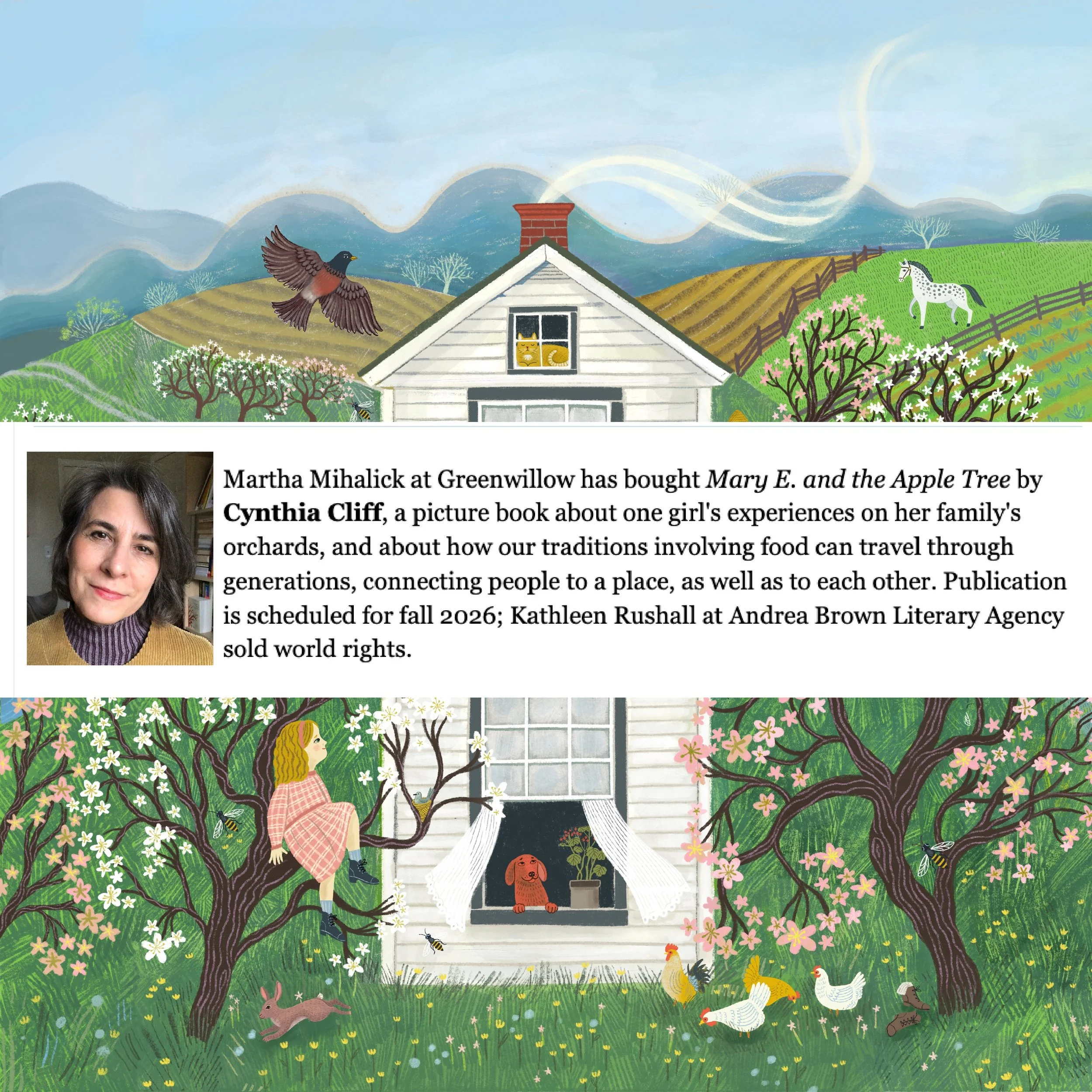
Cynthia: Oh yes! I’d love to share, outside of planning additional adventures for Pepin and friends I am working on two books that are very exciting. One is “Mary E. and the Apple Tree” to be published by Greenwillow Books/Harper Collins, out in 2026. This book is a personal story that I wrote while musing over scores of photographs of my ancestors taken between the 1850’s and early 1900’s—photos I never knew existed until just a few years ago. It is a lyrical story about how Mary Elizabeth, my second great grandmother’s life echoes in my own life and the things that connect us. I am putting a bow on the final illustrations as I write this.

The second book I am working on is with Nancy Paulson Books/Penguin Random House and I am the illustrator for the fabulous author of adult books Virginia Postrel. The book is entitled “Veronica’s Summer of Silk”, and it is Virginia’s debut picture book, a spin off that developed after her creation of the magnificent history book “The Fabric of Civilization.” I’m so excited to work with Nancy and Virginia to create the visual world for this story about a young girl in the silk mill industry in 1680 Italy. I am just getting started on this work, so look for it in 2027.

I am of course always writing new stories and will hopefully start work on a dummy or two for some new book ideas to submit to publishers.


Me: Thank you so much for chatting, Cynthia. Wishing your book much success!

Cynthia: My pleasure, and the same to you. Thank you!

To learn more, please go to Cynthia Cliff.