

Me: Hi, Beth! And congratulations on THOMAS JEFFERSON’S BATTLE FOR SCIENCE: BIAS, TRUTH AND A MIGHTY MOOSE! (Calkins Creek/Astra Books for Young Readers, May, 2024, illustrated by Jeremy Holmes)! In a time when battles over information are all too relevant, it’s interesting to learn that power struggles over facts are not new to American discourse. What inspired you to write this book?
Beth: Thanks, Jonathan! I love untold stories of quirky historical events, so when I read an article about Thomas Jefferson and the moose, it immediately grabbed me as an interesting and unknown piece of history. But, as we know, an fun anecdote isn’t enough. As I thought about how to create a meaningful children’s book, I found so much great potential in the story that rings today and would be of value to kids. The idea that truth and science matter was foremost.

From Thomas Jefferson’s Battle for Science (Calkins Creek/Astra, 2024) Text © Beth Anderson, Illustrations © Jeremy Holmes
Me: After recently working on a non-fiction book of my own, I learned that our plethora of information can still lead to false and conflicting facts, even from some seemingly reputable sources. How did you approach your own research into these events from so long ago? Any fun facts that didn’t make it into your book?
Beth: There’s so much that didn’t make the cut! 😊 This story had some complicated concepts and was larger than what appears in the book. I had to cut it back to use one aspect of Jefferson’s argument so as not to bog down the story. His piece comparing the sizes of quadrapeds was perfect for kids and made the points I needed for the story. Focusing on that (and omitting his other arguments on diversity of species and domesticated animals which overcomplicated) allowed me to clearly detail his research process and put it in terms of scientific inquiry that kids use in school. Once readers understand the basics of bias and misinformation with animals, I could share the heavier pieces of that history of how we measure and define worth and differences with humans, Jefferson’s own biases, and more thought-provoking ideas in the back matter for more in-depth discussion.
As far as the problem of discrepancies in research, for this story I didn’t find conflicting information, but I did find conflicted information—in that Jefferson’s ideas clashed within his own writings. And faulty logic is really part of the story. The Founders Archive online is a tremendous resource. The ability to use Jefferson’s actual correspondence as he gathered data and sought out a moose is key because in those letters you can see the biases and prejudices in the letter writers’ own words, as well as getting context of the times. When you see that Jefferson was recording weather data as Congress debated the Declaration of Independence, there’s no doubt he was obsessed with science. When James Madison shares government business in a letter and follows it with detailed measurements of a weasel, you can see Jefferson wasn’t the only one into science and get a sense of their lives and personalities. One funny piece left out is that the first captain that was supposed to take the dead moose across the Atlantic left it on the dock, increasing the stink as it waited for another ship.
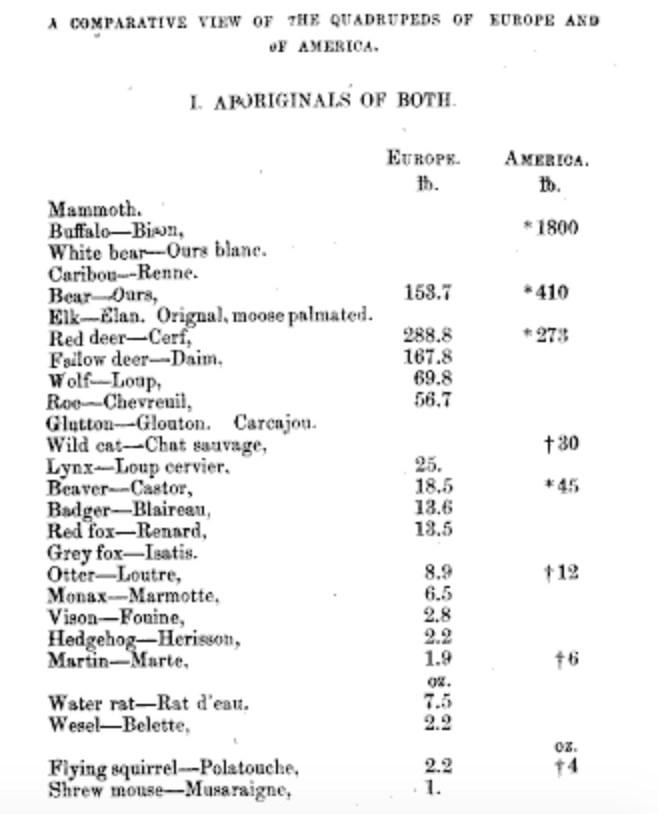
From Notes on the State of Virginia by Thomas Jefferson, 1787
Me: The illustrations by Jeremy Holmes are so beautifully detailed and fun! How did he end up as your illustrator? What, if any, was your collaboration?
Beth: Jeremy’s art is truly phenomenal, and his merging of text and art is seamless. Editor Carolyn Yoder suggested him, and, as a fan of his work, I was all in. The only time there was any collaboration was in the vetting process when we had to change a few things to keep it nonfiction. Jeremy did his own research and added so much to the story. He even found a way to include the bill for the moose, one of “my darlings” that was killed off in revisions—something he wasn’t aware of. We were truly on the same wavelength.
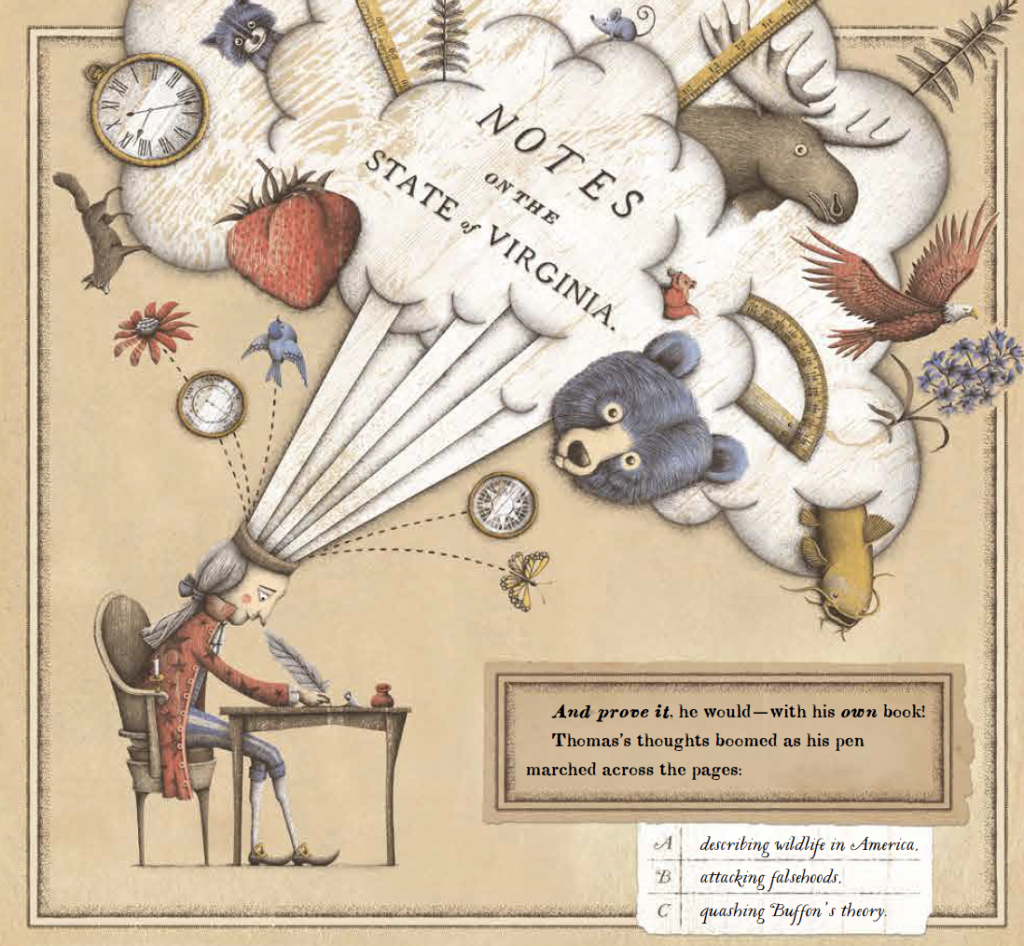
From Thomas Jefferson’s Battle for Science (Calkins Creek/Astra, 2024) Text © Beth Anderson, Illustrations © Jeremy Holmes
Me: How did you get into writing for kids?
Beth: I used “illustrated texts,” aka picture books, throughout my career as an ESL educator. They have the power of beautiful language, communication through art, and the potential to serve any skill you want to teach, as well as facilitating language acquisition, supporting content across the curriculum, and being dignified and accessible. My love of these kinds of books in the classroom led me to attempt “my someday” of writing for kids. After exploring how the industry works and trying to write a variety of genres, I found my niche—true stories that open up a child’s world and thinking.
Me: Can you share what you’re working on next?
Beth: I’m pausing a couple WIPs (works in progress) to do the copy edits on a manuscript now in the publishing pipeline. It hasn’t been announced yet, but I can tell you it’s another “revolutionary” story with a famous founder and a little known part of history that rings very relevant today. As for the WIPs, they will remain top secret for a while.
I’m preparing for the release of HIDING IN PLAIN SIGHT: KATE WARNE AND THE RACE TO SAVE ABRAHAM LINCOLN this coming January. (trailer here: https://www.youtube.com/watch?v=CGDgdEkqprk ) I’m also anticipating Jenn Ely’s sketches soon for a 2026 release (SCULPTING PRESIDENT LINCOLN: VINNIE REAM CARVES OUT HER FUTURE) and the vetting process with those. Clearly, I’m fascinated with Lincoln! All this goes to show there’s much more to do after you finish a manuscript.
Me: Thanks so much for chatting! Wishing your book much success!
Beth: Thank you for inviting me to be a part of your blog!
To learn more, please visit Beth Anderson, Children’s Writer – Reader, Writer, Miner of Moments (bethandersonwriter.com)


Ha! Left the moose on the dock! Why do we often forget the ONE thing we don’t want to forget! That tidbit is gold! Congratulations, Beth and Jeremy!